"I didn't fully understand the future when I chose it. But I believed in it, worked for it, and grew into it."
There's a photo I keep coming back to.
Me, standing in an auditorium at IIT Madras, wearing the maroon and gold IITM graduation stole, holding a degree certificate with both hands — smiling in a way that only makes sense if you know what it took to get there.
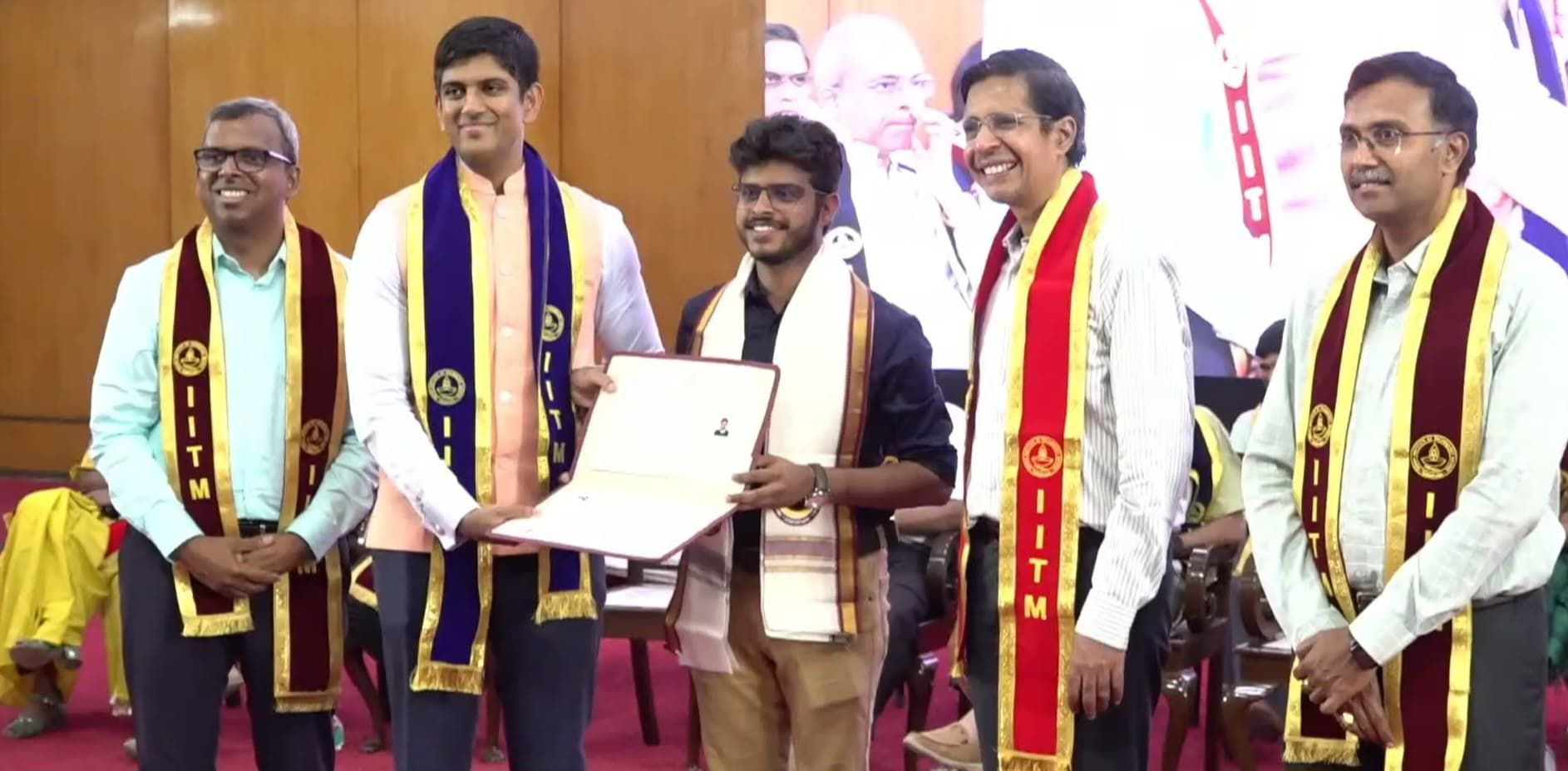
That photo doesn't show the nights that stretched to 2 or 3 AM — not waking up early, but simply never stopping. It doesn't show the semesters I had to carefully ration my IIT courses around my BTech workload like a general managing troops on two fronts. It doesn't show the placement rejections, the deeptech startup I poured myself into and then had to step away from, or the nights I genuinely wondered if I had made the right choices.
What it shows is the result. What this blog is about is everything that came before it.
The Question That Set Everything in Motion
Right after my 10th grade, my father — a tax consultant who had spent his career in finance — sat me down and shared his wish: that I consider becoming a Chartered Accountant.
I said no.
Not out of rebellion. CA is a respected, rewarding career and my father had spent years building expertise around it. But something in me pulled in a different direction — toward Computer Science, Mathematics, and Physics. I couldn't articulate it. It was instinct more than logic.
My father, to his enormous credit, didn't push back. He listened, accepted my decision, and gave me one piece of advice that I've never forgotten:
"If you're choosing Computer Science, find a field that has a future."
That single sentence sent me down a rabbit hole. A 15-year-old with a laptop, too much free time, and a question he needed to answer: What in Computer Science has a future?
Discovering AI — A Coincidence That Changed Everything
It was around 2017 when I first stumbled across Artificial Intelligence during my research.
I wasn't looking for it specifically. I was just a 15-year-old trying to answer my father's challenge — find a field with a future — and AI kept appearing everywhere I looked. In tech news, in research threads, in conversations about where the industry was heading. It wasn't one single article or paper that did it. It was more like a signal coming from every direction at once.
That year happened to be a pivotal shift in AI — the field was quietly undergoing a transformation that most people wouldn't notice until years later. I didn't understand any of the technical details. But I felt something.
Not intellectually. More like a gut feeling — the same feeling you get when you walk into a room and just know something important is happening, even if you can't name it yet.
"This is going to be the future."
I was 15 going on 16. I didn't know what a neural network was. I couldn't tell you what backpropagation meant. I had never trained a model, never touched a dataset, never written a line of Python.
Looking back, it was a coincidence — stumbling into AI at the exact moment the field was about to explode. But that coincidence became a conviction. And I made a decision: I would follow AI — even before I understood it.
That decision, made without full information, without mentors, without any certainty — turned out to be the best one I ever made.
Building the Foundation: +1, +2, and the First Steps
I chose Computer Science as my stream for +1 and +2 and started teaching myself Python. I was building the base — slowly, imperfectly, but consistently.
Somewhere during my 12th, I discovered Andrew Ng's Machine Learning course on Coursera. I started it with full energy. Understood some of it. Got lost in parts of it. Didn't complete it.
That's okay. Sometimes you find a resource before you're ready for it. The important thing is you remember where you left it.
Then came the entrance exams — and reality.
JEE didn't work out.
I'm not going to dress that up. It stung. You spend years preparing, you believe you're capable, and then the result says otherwise. There's a specific kind of disappointment in that.
But I got a strong rank in the Kerala Engineering Entrance Exam, secured my BTech seat, and moved forward.
And then, as I was settling into college life, something new appeared on the horizon: IIT Madras had launched its BSc in Data Science — a fully online, flexible program that anyone could enroll in alongside their existing degree.
I looked at it and thought: "This is exactly what I need."
I enrolled thinking it would be manageable.
I had no idea what I was signing up for.
Chapter 1: The Dual Degree Grind — Managing Two Worlds Simultaneously
Let me be honest about what the dual degree experience actually felt like — not the cleaned-up version you'd tell at a dinner party, but the real one.
The Planning Never Stopped
Every semester began the same way. Before I could think about joining clubs, planning trips, or anything resembling a normal college experience, I had to sit down and do the math:
- How heavy is this BTech semester?
- How many exams, submissions, and lab sessions are packed in?
- Which IIT Madras courses can I realistically take without drowning?
- Which ones should I push to next term?
It was like running two project plans simultaneously — except both had deadlines, both had exams, and neither cared about the other's schedule.
There were terms where I had to deliberately slow down my IIT progress to survive my BTech semester. There were terms where I pushed hard on IIT courses during lighter BTech periods, racing to stay ahead. The whole thing was a constant negotiation between two institutions that didn't know the other existed.
What I Actually Sacrificed
People romanticize hard work. They say "I sacrificed my leisure time" the way someone says they skipped dessert. Let me be more specific.
I missed college fests while sitting with IIT assignments. I watched friends leave for trips I couldn't justify taking. I turned down plans because I had a quiz the next morning — for a degree most people in my college didn't even know I was doing.
Here's what my actual routine looked like during the peak of this phase:
- ~8:00 AM — Wake up, morning habits
- Morning → 5:00 PM — BTech classes
- 5:00 PM → 8:30–9:00 PM — Work on the startup
- 9:00 PM → 2:00 AM — Assignments. Both BTech and BSc. Back to back.
- ~2:00 AM — Sleep
That wasn't a rough week. That was the routine. It didn't change — it just extended when things got busier.
There was no point where I was waking up at 4 AM to be productive. I was staying up until 2 AM because that was the only time left in the day after everything else. The work happened at the end of the day, when everyone else had already gone to sleep.
And the most honest thing I can tell you is: I didn't always feel motivated during those moments. Motivation is a feeling — it comes and goes. What kept me going was a decision I had made and refused to walk back from.
"I will not quit in the middle."
What the IIT Madras BSc Actually Built in Me
The curriculum was rigorous. Mathematics, statistics, data analysis, machine learning foundations, Python programming, databases — all taught at a standard you'd expect from IIT Madras. But beyond the technical content, the program did something else for me.
It made me comfortable with being uncomfortable.
When you're doing two degrees simultaneously, you stop waiting for the "right time" to study, the "ideal conditions" to focus, or the "perfect mood" to get started. You study when you can. You focus because you have to. You get started because the deadline is real.
That's a skill. And it has served me more than any individual course topic ever has.
The Day It Was Over
When I finally walked into that auditorium at IIT Madras, wearing the graduation stole, and held that degree certificate — I didn't just feel proud. I felt a specific kind of relief that only comes from completing something genuinely difficult.
Every professor who had accommodated a schedule conflict, every friend who had shared notes when I was buried, every late night that had somehow led to this moment — it all compressed into that photograph.
Two degrees. One person. Worth every bit of it.
Chapter 2: Falling in Love With Machine Learning — The Real Technical Journey
After the first year of college, something shifted in how I approached learning.
I stopped treating it like coursework and started treating it like obsession.
Mastering the Fundamentals: A Rigorous Path to Machine Learning
Remember the ML course I had started in 12th and never finished? I went back to it in college — and this time, I didn't stop.
But more importantly, this time I didn't just watch and nod. I paused. I pulled up papers. I implemented things from scratch. I asked why the math worked, not just what the formula was.
The difference between someone who can use ML tools and someone who understands ML is the willingness to sit with confusion long enough for it to become clarity. That's what I practiced during this phase.
The Stack I Built
Over the course of college, here's what I actually learned — not a resume line, but how it actually happened:
Python / Pandas / NumPy — Started as syntax, became second nature. There's a point where you stop thinking about the code and start thinking about the problem. That transition took about a year of daily use.
Classical ML (Scikit-learn, XGBoost) — Regression, classification, clustering, ensembles, feature engineering, cross-validation. I learned these by building things, breaking them, reading the error messages, and rebuilding. Kaggle competitions helped. So did real projects where the data was messy and real.
Deep Learning (PyTorch / TensorFlow) — This is where things got genuinely exciting. CNNs for vision, RNNs for sequences, attention mechanisms, transformers. I could finally go back and read the research that had been shifting the AI world since 2017 — and now actually understand it. The concepts I had sensed as a teenager without grasping them finally had names, math, and meaning.
LLMs and Generative AI — This became my deepest area. RAG pipelines, fine-tuning, prompt engineering, vector databases, LangChain, building end-to-end systems around large language models. This is where I spent the most time and where I did my most meaningful work.
Research: Learning to Think Rigorously
At some point during college, I started contributing to research — and eventually had work accepted at IEEE and published in journals.
Research changed how I think in a way that's hard to overstate. When you're building projects, you're asking: "Does this work?" When you're doing research, you're asking: "Why does this work? Under what conditions? What are the limits? What does this tell us about the underlying problem?"
That shift in questioning — from pragmatic to rigorous — made me a better engineer. Because now, when I build production systems, I understand not just how to make them work, but why they work, and therefore, how to fix them when they don't.
Chapter 3: Building Real Things — Startups, Robots, and AI Systems
The phase after my foundation was set is the one I'm most proud of — not because everything went well, but because I stopped waiting for permission to build.
The Hackathon Phase
Hackathons were my testing ground. The pressure of building something in 24-48 hours, pitching it to judges, defending your design decisions — it forces you to make fast decisions under uncertainty.
I won. Multiple times.
But more valuable than the wins was what I learned from the losses. A judge who tells you why your approach is wrong in 2 minutes teaches you more than a week of self-study.
Founding Engineer at Corr Robotics: Scaling AI in Deeptech
The startup was the crucible.
I joined Corr Robotics as their Founding Engineer, responsible entirely for the AI/ML layer. This was a deeptech challenge at the intersection of AI and robotics, where model errors didn't just produce wrong outputs—they had physical consequences. The AI was the product, meaning the technical decisions I made were the ones the company would live or die by.
What I actually did day-to-day:
- Designing the AI/ML systems architecture from scratch
- Deciding what to build in-house vs. what to use off the shelf — and owning the consequences of those calls
- Scaling the infrastructure as the product grew (eventually reaching a ₹5 crore valuation)
- Translating complex model decisions into language non-technical co-founders and early investors could understand and trust
- Building and deploying real AI systems that ran in the physical world, sharpening my focus on reliability and production-readiness
This role felt surreal. To a college student running on 5 hours of sleep and three simultaneous commitments, reaching that valuation felt like proof that the idea — and the work — was real.
Deeptech is relentless. There's always a technical edge case, a model that degraded in production, or a deadline that moved up without warning. When you're the only AI person on the team, that weight is entirely yours.
Stepping Away — The Hardest Decision
Due to personal circumstances, I eventually made the decision to step down from the startup.
I'm going to be honest: this was one of the hardest things I've done. Walking away from something you built, something you poured years of your life into, something that was working — there's a grief in that that doesn't get talked about enough in the startup world.
But it was the right call. And I've learned that knowing when to step back is not weakness — it's wisdom.
Chapter 4: The Placement Wall — My Lowest Phase and How I Climbed Out
Then came placements. And they humbled me in a way nothing else had.
The Shock of Rejection
By the time placement season started, my profile looked strong — at least on paper:
- Dual degrees (BTech + IIT Madras BSc Data Science)
- Founding Engineer in AI at Corr Robotics (Deeptech Startup, ₹5 crore valuation)
- Published research (IEEE + journal)
- Production AI/ML systems
- Hackathon wins
And yet the rejections came. Consistently. Sometimes with feedback, more often without.
But the part that made it hardest wasn't just the rejections themselves.
It was watching everyone around me get placed.
One by one, my friends received offers. The group chats lit up with news. People celebrated. I celebrated with them — genuinely — but every update was also a quiet reminder that I was still waiting. Then I was one of the few without an offer. Then I was the only one in my immediate circle.
That specific kind of aloneness is hard to describe. You're surrounded by people who care about you, who are happy and moving forward, and you're standing still — not because you stopped trying, but because it just wasn't working yet.
The rejections came in different flavours too. Some rounds I got eliminated in the first coding round — not even making it to a conversation. Others I made it through the technical stages only to be cut at the HR round, which almost felt worse. You start wondering: is it the skills? the fit? the way I present myself? all of the above?
The silence after an interview you thought went well is its own specific kind of difficult. You replay it. You wonder what you missed. You question whether your work is as strong as you believed.
I went through every version of that.
The Danger Zone: When Doubt Becomes a Story
There's a point in a streak of rejections where the mind starts building a narrative. "Maybe I'm not good enough. Maybe I built the wrong things. Maybe I should have focused on competitive programming instead of real projects."
That narrative is dangerous — because it's partly constructed from real data (rejections) but mostly constructed from fear.
I had to actively separate the signal from the noise. Not every rejection means your work is wrong. Sometimes it's positioning. Sometimes it's timing. Sometimes it's genuinely just luck.
The key is: analyze what you can control, and don't spiral about what you can't.
What I Actually Changed
I did a real audit of my approach. Not self-criticism — an honest diagnostic. Here's what I found and fixed:
Communication — I was explaining my work the way an engineer explains it to another engineer. But interviews are conversations, not technical presentations. I learned to tell the story of my work — the problem, the decision, the outcome — not just the architecture.
Positioning — "I built this and this and this" is a list. "Here's the thread connecting everything I've built, and here's the kind of problem I'm uniquely equipped to solve" is a story. Recruiters and hiring managers respond to the story.
Consistency — I kept applying. This sounds obvious. It isn't. When you're drained from rejections, the hardest thing is to send one more application with the same energy as the first. I did it anyway.
The Breakthrough
Toward the end of placement season, the dynamic shifted.
Multiple offers came in.
Not one — multiple. After months of silence, the doors opened. I had time to choose, to evaluate, to negotiate.
I chose to join Rappit as an AI/ML Engineer — even though it meant turning down a much higher-paying offer from TCS.
I chose Rappit because it was exactly the domain I had been building toward since 2017: LLMs, Generative AI, and production ML systems. Choosing the dream role over the bigger paycheck was one of the easiest decisions I've ever made.
The technology I had chosen as a 16-year-old, before I understood what it was.
That felt like full circle.
What All of This Actually Taught Me
Seven years is a long time. Here's what I carry from it:
1. Commitment matters more than clarity
I chose AI before I understood transformers, gradient descent, or matrix multiplication. The commitment came first. Everything else followed from that commitment. You don't need a perfect plan — you need a strong enough direction.
2. Failure is data, not verdict
JEE. Placements. Stepping away from the startup. None of these were the end of the story. Each one was information — about what to adjust, what to strengthen, what to let go. The only way to lose is to stop learning from what isn't working.
3. The grind phases build things that comfortable phases never could
Managing two degrees while everyone around me had more free time than I did — that period built something I couldn't have bought or shortcut. Resilience. Discipline. The ability to function under pressure without losing the plot.
4. Real learning is building things that break and fixing them
Courses teach you concepts. Projects teach you judgment. Research teaches you rigor. You need all three — but the building is what makes the others real.
5. Persistence is the most underrated skill in any technical career
Not talent. Not connections. Not even which university you went to. Persistence — the ability to keep improving and keep showing up after every setback — is what separates the people who eventually break through from the people who don't.
6. Start before you're ready
I was not "ready" to co-found a startup. I was not "ready" to be a Founding Engineer. I was not "ready" to publish research. I became ready by doing those things. Readiness is a myth — action is the only thing that makes you ready.
A Note of Gratitude
None of this happened in isolation.
To the teachers at both IIT Madras and my BTech college who worked around deadline clashes and never let me fall through the cracks — thank you. You treated a dual-degree student as a real student, not an inconvenience.
To the friends who shared notes when I was buried, who covered for me, who kept me sane through the chaos — you know who you are.
And to my parents — who never once questioned the path I chose, who believed in me through the JEE failure, through the startup struggles, through the placement silence — thank you. Everything I've built starts with the foundation you gave me. 🙏
One Last Thing
If you're somewhere in the middle right now — managing too many things, getting too many rejections, wondering if the sacrifices are worth it — I want to say something directly to you:
They are.
Not because it always works out perfectly. But because the person you become by pushing through something genuinely hard is someone who can handle what comes next.
The future rewards the ones who stayed.
This is the first post in a series where I'll be writing about AI/ML, building in public, career lessons, and everything I'm learning at Rappit. If this resonated, follow along — more coming soon.
*Connect with me on LinkedIn
© Vyshakh · April 2026